
Our services
Sofa Spring & Sagging Seat Repair
When a sofa seat sits too low, tips you towards the back or feels like it has nothing underneath it, the problem is in the seat structure rather than the covering. That structure is usually one of two things: the springs or webbing supporting the seat from below, and the filling inside the cushion itself.
Both are repairable, and both are worth repairing on a sofa whose frame and upholstery are otherwise sound. Replacing a suite because the seats have gone soft means throwing away a frame that is very likely still perfect.
We repair sofa springs and sagging seats across Durham, Tyne and Wear and Teesside, on leather and fabric furniture alike — this repair is not limited to leather.
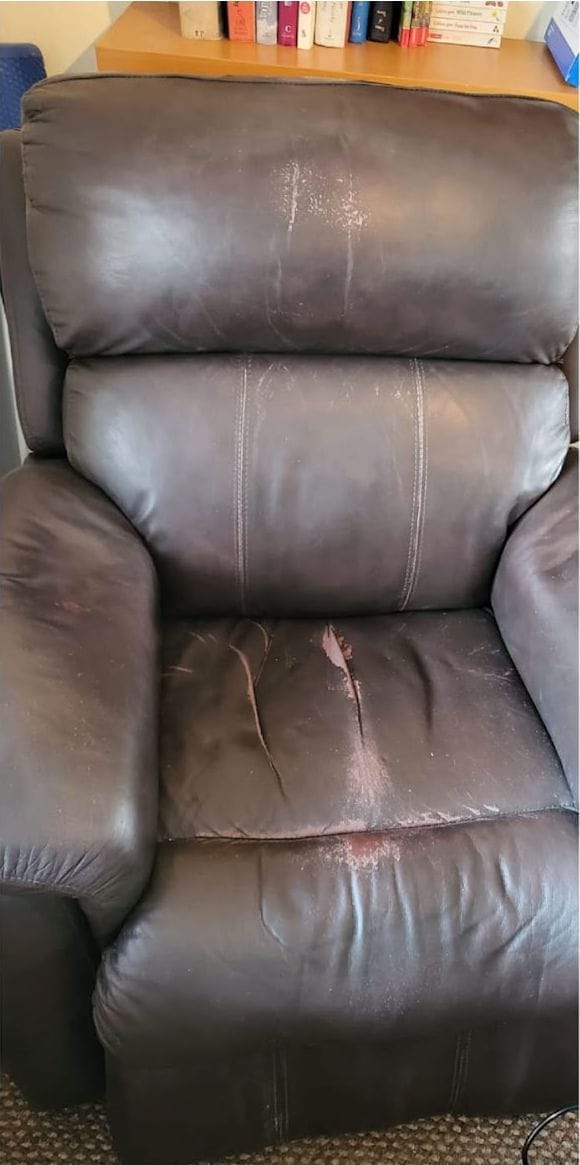 Before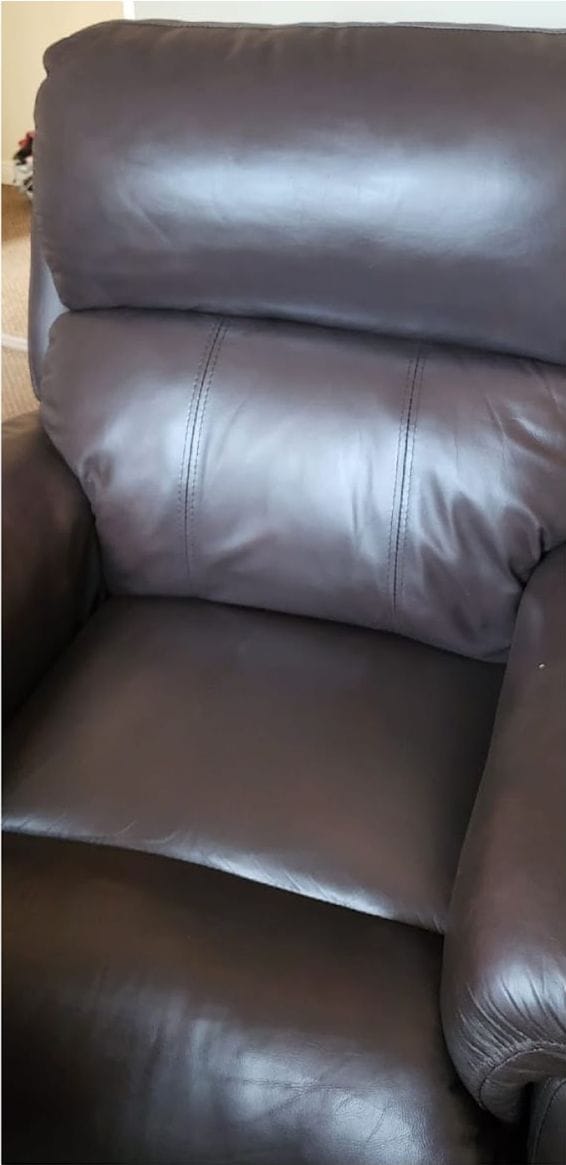
Brown leather recliner armchair with a torn seat panel and worn headrest before repair
What we repair
Seating problems we repair
If what has gone wrong with yours is not listed here, send a photo — it is usually a variation on one of these.
Broken springs
A snapped serpentine or coil spring lets one part of the seat drop away. You can usually feel it as a distinct dip in one spot, and often hear it as a click or a twang when you sit down.
Weakened and stretched springs
Springs that have not broken but have lost their tension. The seat sits noticeably lower than it did and feels soft across the whole width rather than dipping in one place.
Failed webbing
Many sofas use elasticated or jute webbing rather than steel springs. Webbing stretches and eventually tears away from the frame, letting the seat sag towards the floor.
Flattened cushion filling
Foam that has compressed and no longer recovers, or fibre filling that has migrated to the edges leaving a hollow in the middle. The cushion looks thin and creased and offers no support.
Seats that tilt or sit unevenly
One seat lower than the one beside it, usually because a spring or webbing run has failed on one side while the other is intact.
Noisy seats
Creaking, clicking or grinding when you sit or shift your weight, which normally points to a spring that has broken free of its clip or a frame joint that has worked loose.
The repair
How the repair works
Finding out what has actually failed
A cushion that feels flat and a spring that has broken feel similar from above but need entirely different repairs. The seat has to be looked at from underneath — the lining beneath the sofa is opened up so the springs, webbing and frame can be seen directly.
Repairing or replacing the support
Broken springs are replaced and refixed to the frame; stretched webbing is renewed and re-tensioned. Where clips or fixings have pulled out of the frame, those are made good too, since a new spring in a failed fixing will not last.
Rebuilding the cushion
Where the filling has collapsed, cushions are restuffed or the foam interior replaced. Cushion covers are opened and re-closed rather than replaced, so the leather or fabric you already have stays as it is.
Checking the frame
Seat failures often go with a loose frame joint. Any movement in the frame is dealt with at the same time, because a sound seat on a loose frame will simply fail again.
Balancing the seats
Finally the seats are checked against each other for height and firmness. A repaired seat that is noticeably firmer than the one next to it is only half a repair.
Repair or replace
Why repair the seat rather than buy a new sofa
Seat support is a consumable part of a sofa. Springs, webbing and foam are all designed to be renewed, and they wear out long before a well-made frame does. Replacing the whole piece because the seats have softened means discarding a frame with years left in it.
It is also usually the cheaper route by a wide margin, particularly on larger suites and corner units where replacement means dealing with delivery, access and disposal on top of the purchase price.
And where the upholstery is still good — or has just been recoloured — a seat repair means you keep a piece that already fits the room and matches everything else in it.
When a repair is not the answer
Some seating is not economic to repair. Furniture built on stapled particleboard frames rather than timber often cannot hold a new fixing securely, and where the frame itself has broken across a load-bearing member the repair may cost more than the piece is worth. Recliner and sofa-bed mechanisms are a separate specialism — if what has failed is the mechanism rather than the seat, we will tell you rather than take the work on. Photographs, including one taken from underneath if you can manage it, help us judge this before quoting.
Our work
Repairs we have carried out
Switch between before and after to see the difference on each job.
BeforeBrown leather recliner armchair with a torn seat panel and worn headrest before repair
Next step
How to get a quote for sofa spring repair
Photographs are what let us quote accurately without arranging a visit first. Send them with a sentence about what has gone wrong and we will come back to you.
- A close-up of the worst-affected area
- One photo of the whole piece for context
- Taken in daylight rather than under a lamp
- Your postcode, so we can confirm we cover you
Questions
Sofa Spring & Sagging Seat Repair — your questions answered
Can a sagging sofa seat be repaired?
In most cases yes. Whether the fix is new springs, renewed webbing or restuffing the cushion depends on what has actually failed underneath, which is why the seat needs looking at from below rather than judged from the top.
Can broken sofa springs be fixed?
Yes. Broken springs are replaced and refixed to the frame, and any fixings that have pulled loose are made good at the same time. If several springs have gone it is often worth renewing the whole run rather than one at a time.
How do I know if it is the springs or the cushion?
A rough guide: take the cushion off and press down on the platform underneath. If the platform itself gives way or you can feel a dip, it is the springs or webbing. If the platform feels firm but the cushion is flat and creased, it is the filling. If you are not sure, say so and we will check.
Do you restuff sofa cushions?
Yes, where the filling has collapsed. Covers are opened and re-closed rather than replaced, so the existing leather or fabric stays exactly as it is.
Do you repair fabric sofas as well as leather?
For spring, webbing and seat work, yes — that repair is about the structure underneath, so the covering material makes little difference. Our colour and restoration work is leather only.
More on our frequently asked questions page.
Free quote
Get a price for sofa spring repair
Use the calculator for a guide price, then send photos of the damage for an accurate quote. Both take a couple of minutes and neither commits you to anything.
1. Estimated price
Choose the item, the repair and the number of seats, then calculate to see an estimated guide price.
- · Quotations are free and carry no obligation
- · Most repairs are carried out in your home
- · Photos give you an accurate price, not an estimate
Calculator results are an estimated guide only. A final quotation depends on the actual damage, the type and condition of the leather, and may require photos or further assessment.
2. Request your free quote
Related
Other repairs we carry out
Where we work
Where we carry out sofa spring repair
We cover County Durham, Tyne and Wear and Teesside from our base at South Hetton. Choose your area for local details.
Ready to sort your sofa spring repair?
Send us a few photos of the damage and we will come back to you with a free quotation and an honest view of the result you can expect.